
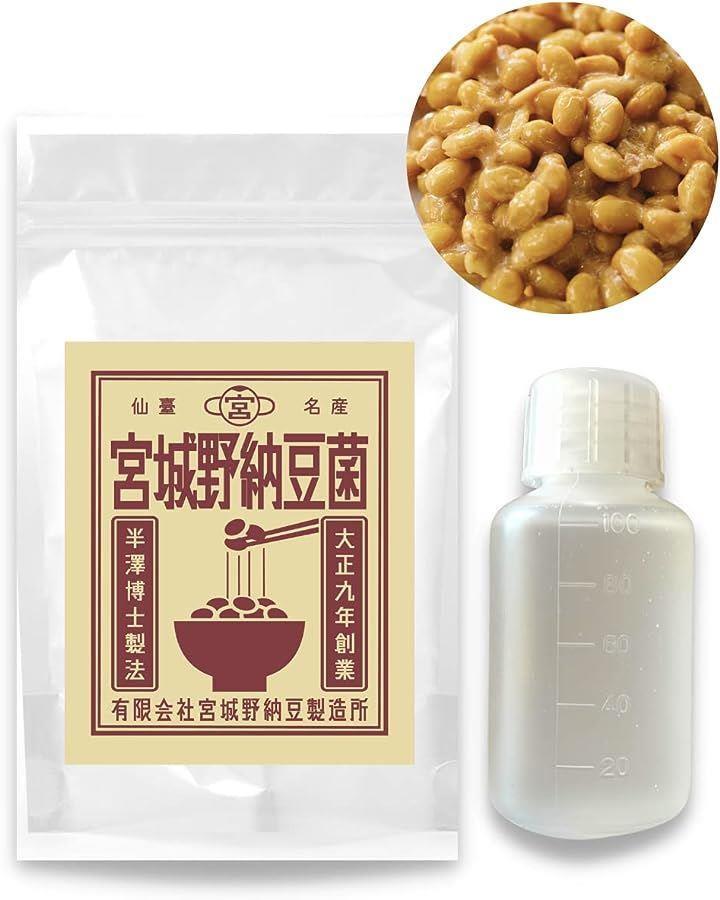
Product Details Product Name: Miyagino Natto Bacteria Name: Natto Manufacturing Bacteria Ingredients: Sterilized water, Natto bacteria Content: 100ml Expiration Date: 1 year from the date of manufacture (listed on the label of the outer bag) Storage Method for Natto Bacteria: Before opening, keep at room temperature / After opening, keep refrigerated / Do not freeze Manufacturer: Miyagino Natto Manufacturing Co., Ltd. Comes with a manual on how to make natto from Miyagino Natto Manufacturing Co., Ltd., so anyone can easily make it. One bottle of 100ml natto bacteria can produce approximately 100kg of natto.
Enjoy daily meals with gentle homemade natto that is easy on your body.
Founded in Taisho 9 (1920).
Trusted and proven high-quality "Miyagino Natto Bacteria"
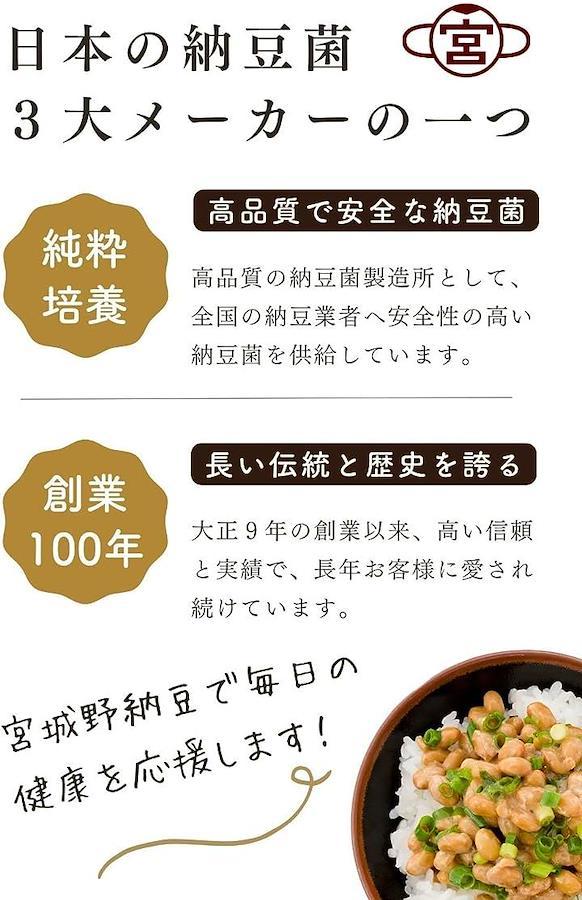
As a high-quality natto bacteria manufacturer, we supply bacteria to natto producers nationwide.
We have consistently aimed to preserve and cultivate the taste of Japan, continuing our diligent efforts.
"Unchanging quality since the first generation"
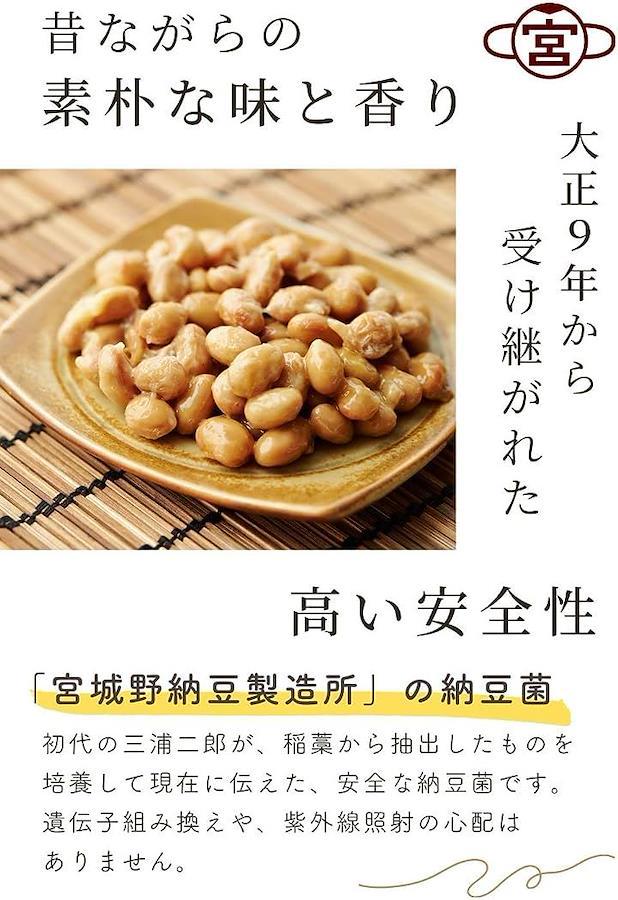
The natto bacteria was extracted from rice straw by the first generation, Jiro Miura, and has been passed down to the present day through cultivation.
It is a clear, odorless liquid type.
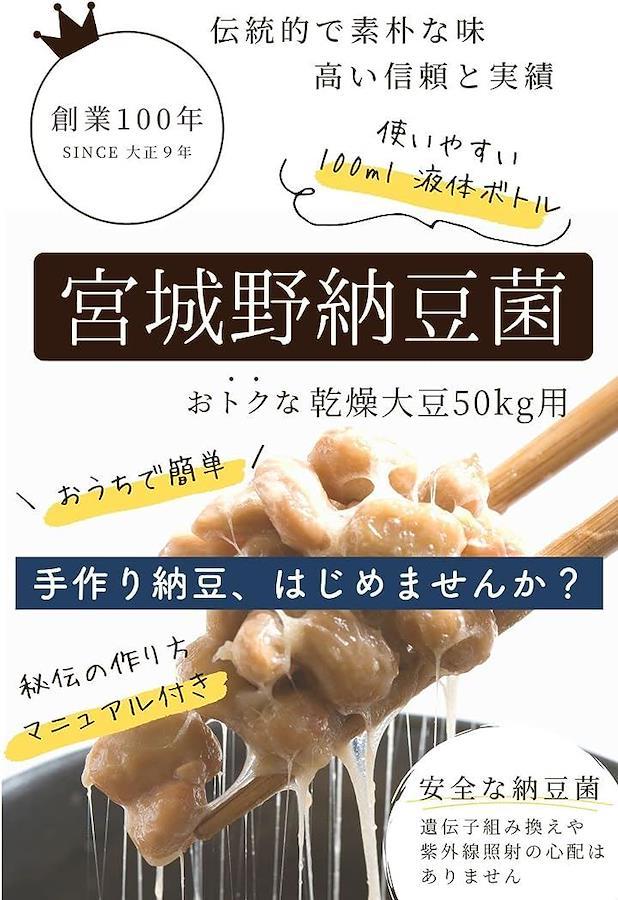
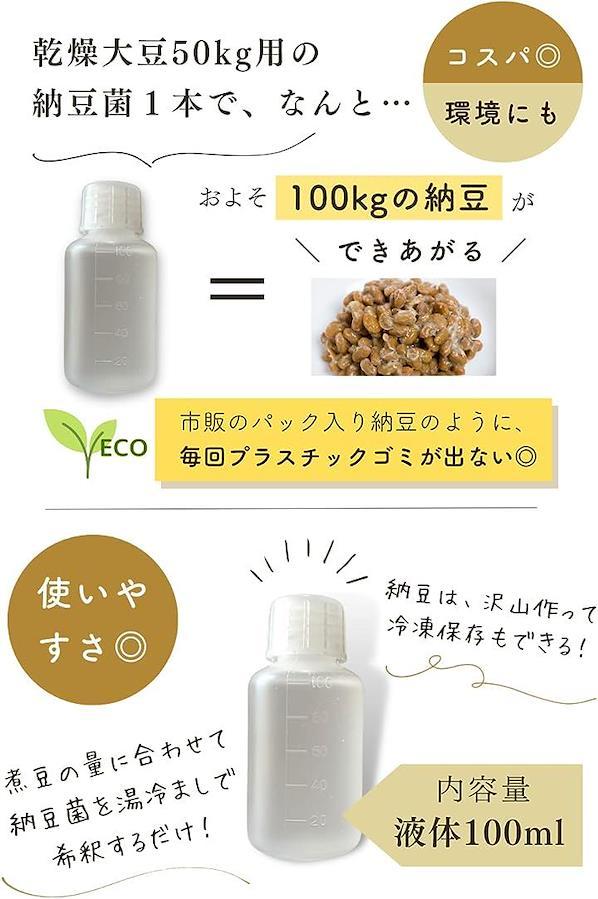
With one bottle (100ml) of natto bacteria for 50kg of dried soybeans, about 100kg of natto can be produced.
There is no concern about genetic modification or ultraviolet irradiation.
"Traditional and simple flavor"
You can enjoy the taste and aroma of traditional natto.
Because it has a simple flavor without unnecessary additions or subtractions, it has been loved by many customers over the years.
"Gentle on the body and the environment"
Like commercially available plastic-packaged natto, it produces no waste each time, making it environmentally friendly.
You can make a large amount and freeze it for storage.
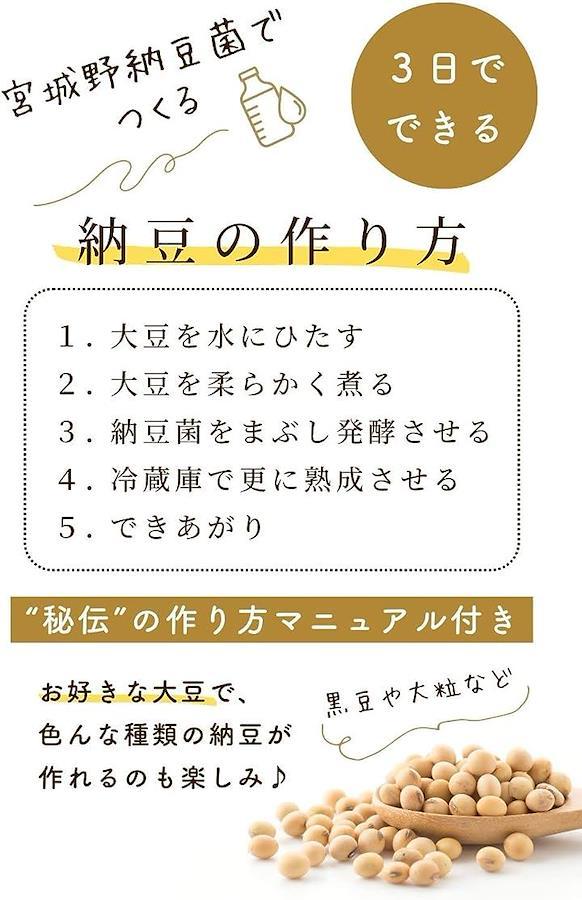
Use your preferred soybeans (large, small, black soybeans, etc.) and enjoy the differences in sweetness and aroma of the soybeans.
History of Miyagino Natto Manufacturing Co., Ltd.
Discovery of Natto Bacteria
Until the Taisho era, natto was made using straw, but it was unhygienic and the quality was unstable.
In the Meiji era, Professor Jun Hansawa of present-day Hokkaido University succeeded in isolating bacteria in his laboratory that could produce natto.
Thanks to his research, natto bacteria were attached to boiled soybeans, and by managing temperature and air exchange, a path to stable large-scale production was opened.
Hansawa's Cultivation Method
The first president of Miyagino Natto Manufacturing Co., Ltd. learned from Professor Hansawa and began developing their own natto bacteria from Taisho 10 (1921).
He was strongly interested in helping Japanese build strength comparable to Westerners, focusing on the high nutritional value of natto.
He focused on producing hygienic natto using natto bacteria, but repeatedly failed in temperature control and struggled to create a suitable environment for natto production.
One day, he was inspired when he saw a piece of snow covered with compost on a farm road, with a hole from which steam was rising.
"That's it, a vent hole."
This led to the development of a culture room suitable for temperature regulation in natto production.
Trial and error and evolution
In 1939 (Showa 14), the first president became a director of the National Natto Association.
Just when things seemed to be going smoothly, war struck Japan, and natto production was halted from Showa 19 to 27 (1944-1952).
Natto production resumed in 1953 (Showa 28).
The second generation, Ichio Miura, worked on developing a pressure-type rotary kettle.
In 1967 (Showa 42), the sale of natto in PSP containers began, and through continuous trial, error, and evolution, the company has thrived through the Showa era.
A historic and valuable factory
A factory built in the early Showa period.
Registered as a tangible cultural property by the Agency for Cultural Affairs, Ministry of Education, Culture, Sports, Science and Technology.
The process, which was entirely manual, began to incorporate partial mechanization.
By integrating modern technology with the wisdom and efforts accumulated by previous generations, we deliver natto bacteria.
Includes a helpful manual!
Detailed instructions for making about 1kg of natto using 500g of dried soybeans are included.
Make plenty and freeze for storage.
Please enjoy your homemade natto as part of your daily meals.
Why not try making your own natto with our homemade recipe?
* As a side dish
Natto is delicious simply with soy sauce or salt, but...
Natto can also be the main dish, a star ingredient.
For example, a simple "Tonpiyaki" sandwich with cabbage and pork.
Adding cheese also sounds delicious.
* Spread on toast
Natto rice is a classic, but "natto toast" is also very tasty.
Why not change your usual breakfast a little?
Try topping with shirasu, cheese, green onions, seaweed, and more, and enjoy crispy, fluffy, delicious natto toast.
* Also suitable for pasta
How about trying "natto pasta"?
A Japanese-style pasta loaded with ingredients like okra, shirasu, green onions, pork, kimchi, and seaweed is very satisfying.
Enjoy many variations of natto recipes that go well with various ingredients, and add color to your daily table.
Manufacturer: Miyagino Natto Manufacturing Co., Ltd.
4-29 Ginnancho, Miyagino-ku, Sendai City, Miyagi Prefecture, Japan
Country of origin: Japan
・"Great value large capacity" Can produce natto from 50kg of dried soybeans.
・"High safety" Safe natto bacteria with no concerns about genetic modification or ultraviolet irradiation.
・"One of Japan's top three manufacturers" Natto bacteria from Miyagino Natto Manufacturing Co., Ltd., with over 100 years of tradition and history.
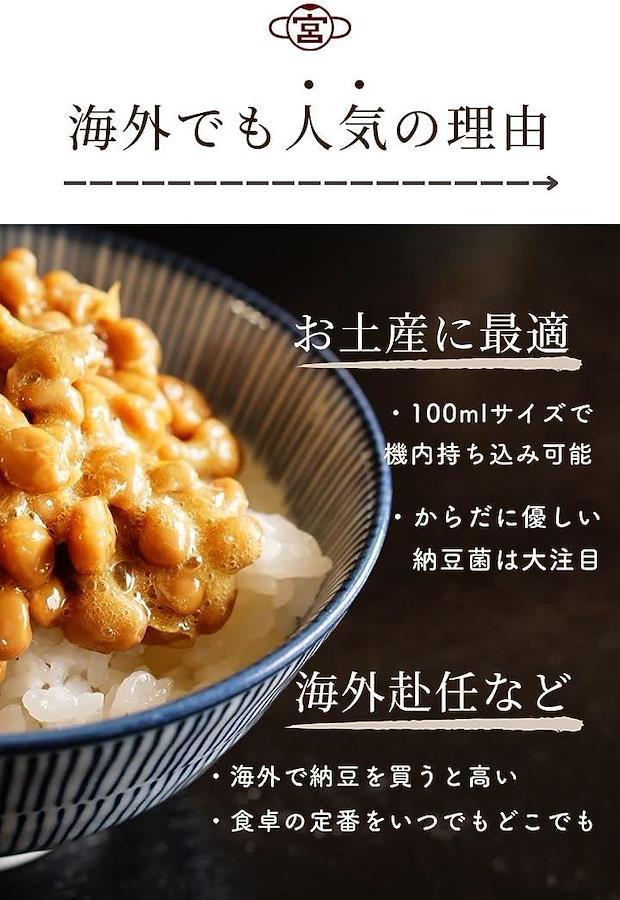
・"Easily enjoy natto overseas" You can enjoy Japanese natto, which is expensive abroad, locally.
・"Includes a making manual" Comes with a secret manual so even beginners can easily make natto.
Usage precautions: To prevent sedimentation, shake the bottle well before each use to ensure uniform concentration.
Thoroughly disinfect hands and tools during all steps of natto making.
Temperature control is very important in natto making.
Also, natto bacteria require oxygen to work.
If you are making it for the first time, please read the manual carefully and use it as a reference.
If the natto does not stretch or emits an abnormal smell, it may be contaminated with bacteria, so do not eat.
Store opened natto bacteria in the refrigerator.
2025/01/31 17:29:10#56fd8c3ba43e40afe13dbf71a4017dfb6e69db69
| Product # | 2B2Q24RL1Q |
|---|---|
| Specifications |
サイズ: 計量カップなし |
You don't need to be in Japan to shop here. Sign up for a free account on ZenPlus now and enjoy buying and shipping to over a hundred countries, directly from Japanese online stores. You can ship your items internationally through JP Post (EMS, Airmail), UPS, DHL, FedEx, and other services. Get all the hottest items from Japan such as anime figures, Nendoroids, Nintendo and other video games, Hello Kitty and other kawaii plushies, fishing tackle, Japanese street fashion, Seiko and other watches from Japan, ramen and other Japanese foods, idol merchandise, and much, much more!
We work directly with Japanese shops registered with ZenPlus, so all internal processes are faster and more efficient - the result is a swift and affordable service, ready for you when you need it most. You have instant access to over 1,000 stores in Japan with just one click! Shop just as if you were in Japan, without spending a fortune. We'll get you the best deal possible from a vast collection of items from Japan. Join the ranks of people who prefer ZenPlus as their Japanese online marketplace.
We protect you, the buyer. Communication can be one of the biggest barriers when buying from Japan online, but it doesn't have to be that way. With ZenPlus, you are protected from many of the risks of international e-commerce: We'll take care of any questions, claims, and requests for the seller that you might have. We can provide a full refund if an item is not genuine, and a partial refund if it's not as promised. Feel free to ask us for more info about any of the items or shops on ZenPlus!