
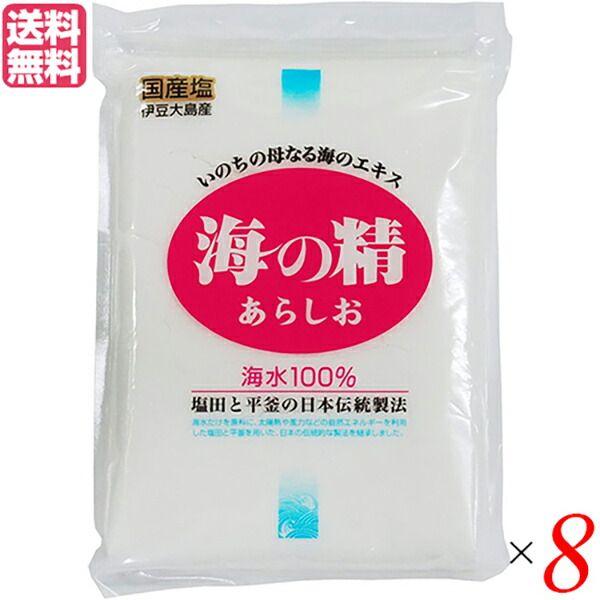
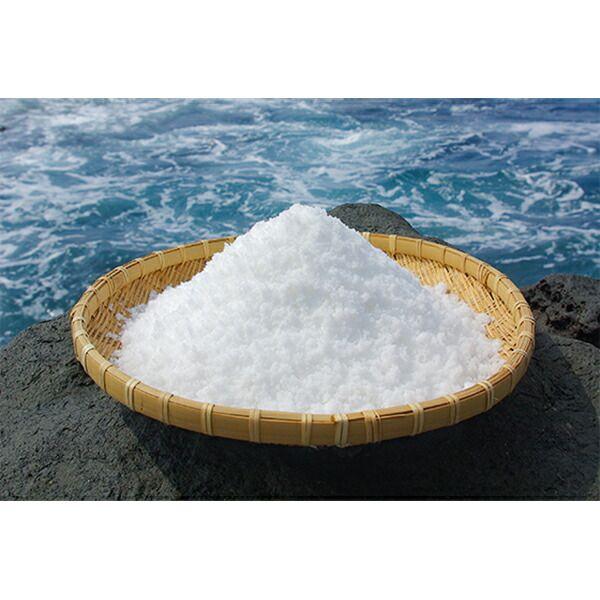
Umi-no-Sei Arashio is the quintessential traditional sea salt passed down in Japan!
In 1972, salt fields disappeared from Japan, and all domestic salt production using seawater as a raw material switched to the ion-exchange method. "Umi-no-Sei" is a traditional Japanese sea salt revived by consumers seeking traditional salt.
The production site is Izu Oshima, a remote island surrounded by beautiful nature. The raw material is 100% pure seawater carried by the Kuroshio Current. No other raw material salts are used.
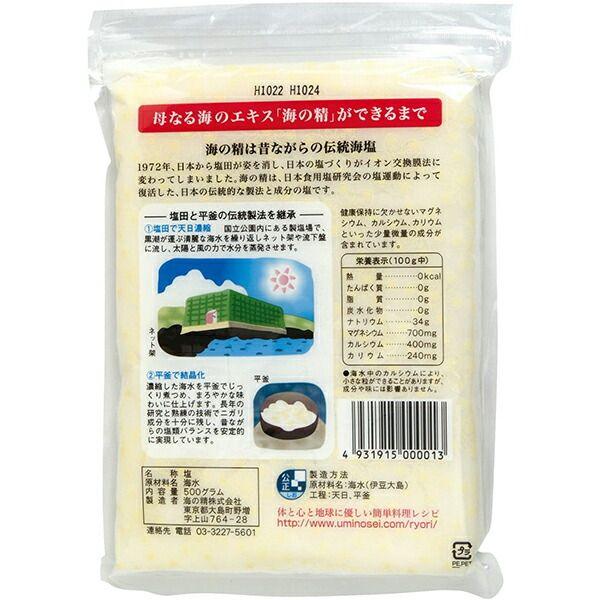
The manufacturing method inherits traditional Japanese production techniques that utilize the power of the sun, wind, and fire, while adding unique innovations. Seawater is concentrated in net-rack flowing-type salt fields and crystallized in steam-heated open pans.
Regarding its components, it contains not only sodium chloride but also small and trace elements essential for maintaining life, such as magnesium, calcium, and potassium. The reason traditional Japanese sea salt (Arashio) is moist is that it contains a moderate amount of bittern (nigari) components derived from seawater.
The taste is not just salty; it has a subtle sweetness, umami, richness, and a sharp finish. It possesses a complex, nostalgic flavor derived from seawater. When used in cooking, it brings out the sweetness and umami of the ingredients, creating a delicious flavor.
While suitable for all types of cooking, the unique deliciousness of traditional Japanese sea salt is best understood in simple salt-flavored dishes. It is ideal for rice balls, salt-rubbed vegetables/salads, salt-based soups, salt-steaming, salt-simmering, salt-sauteing, pickling, and as an accompaniment to sake. Adding a pinch when cooking rice highlights the deliciousness of the grain.
*This is a domestic salt where both the raw materials and the product are produced in Japan using domestic seawater.*The raw material is 100% seawater; no other raw material salts or bittern are added.
### What Makes It Different (1): Origin, Raw Materials, and Manufacturing
**The Origin is Different! Izu Oshima, a Remote Island Hit by the Kuroshio Current**Traditional sea salt "Umi-no-Sei" is a precious domestic salt produced directly from seawater on Izu Oshima, a small island in the Pacific Ocean surrounded by beautiful nature, known as the island of "Gojinka" (the fire of the gods) where camellias bloom.● Many salts generally thought to be domestic are actually made by processing imported foreign salt within Japan.
**The Raw Material is Different! Zero Raw Material Salt, 100% Seawater**Traditional sea salt "Umi-no-Sei" uses only pure seawater carried by the Kuroshio Current, collected at a salt production site within a national park. No foreign raw material salt is added at all.● Many salts generally thought to be made from seawater are actually produced by adding seawater or bittern to high-purity solar salt imported in bulk from overseas.
**The Manufacturing Method is Different! Traditional Japanese Style: Sun, Wind, and Fire**"Umi-no-Sei" inherits traditional Japanese salt-making methods (Agehama, Irihama, and Ryuka styles) that utilize the power of the sun, wind, and fire, while adding unique improvements to ensure quality and stability.
* **Solar Evaporation:** Seawater is repeatedly run through net-rack flowing-type salt fields, using the natural energy of the sun and wind to evaporate moisture and concentrate the seawater.* **Open Pan (Hiragama):** The concentrated seawater is placed in steam-heated open pans and carefully boiled down over a gentle heat to cause the complex precipitation of inorganic salt crystals.* **Draining (Dasshu):** Once boiled, the components and crystal shapes are adjusted, and the bittern (uncrystallized nigari liquid) is separated.* **Packaging:** The amounts of calcium and magnesium—important components that characterize "Umi-no-Sei"—are analyzed for every lot to confirm the mineral balance. The finished salt is carefully inspected during packaging.
### What Makes It Different (2): Components, Taste, and History
**The Components are Different! Plentiful Small and Trace Inorganic Minerals**Because "Umi-no-Sei" is made by concentrating whole seawater containing over 80 types of elements, it contains small and trace inorganic elements such as magnesium, calcium, and potassium in addition to sodium.
**
| Product # | UMISEI-ARASHIO8 |
|---|
You don't need to be in Japan to shop like the Japanese. Sign up for a free account on ZenPlus now and enjoy buying and shipping to over a hundred countries, directly from Japanese online stores. You can ship your items internationally through JP Post (EMS, Airmail), UPS, DHL, FedEx, and other services. Get all the hottest items from Japan such as anime figures, Nendoroids, Nintendo and other video games, Hello Kitty and other kawaii plushies, fishing tackle, Japanese street fashion, Seiko and other watches from Japan, ramen and other Japanese foods, idol merchandise, and much, much more!
We work directly with Japanese shops registered with ZenPlus, so all internal processes are faster and more efficient - the result is a swift and affordable service, ready for you when you need it most. You have instant access to over 1,000 stores in Japan with just one click! Shop just as if you were in Japan, without spending a fortune. We'll get you the best deal possible from a vast collection of items from Japan. Join the ranks of people who prefer ZenPlus as their Japanese online marketplace.
We protect you, the buyer. Communication can be one of the biggest barriers when buying from Japan online, but it doesn't have to be that way. With ZenPlus, you are protected from many of the risks of international e-commerce: We'll take care of any questions, claims, and requests for the seller that you might have. We can provide a full refund if an item is not genuine, and a partial refund if it's not as promised. Feel free to ask us for more info about any of the items or shops on ZenPlus!