
★ Salt concentration: 12%
★ Koji ratio: 22-bu (Note: What is Koji ratio?)
★ Best before date: 7 months
Storage instructions: Avoid direct sunlight; store in a cool, dark place.
★ Ingredients:
- Organic barley (Produced in Shiga Prefecture in 2015)
- Organic soybeans (Produced in Hokkaido in 2014)
- Sea salt (crystal salt from salt fields)
※ What is Koji ratio (こうじぶあい)?
The ingredients list includes Koji ratio, which indicates the proportion of Koji in the miso recipe.
For example, if you have 10 kg of soybeans and 8 kg of Koji before fermentation, the Koji ratio is 8-bu. This is a very sophisticated way of describing it, often preferred by connoisseurs who like higher-grade miso.
A Koji ratio of 22-bu means that for 10 kg of soybeans, the recipe uses 22 kg of Koji.
**Understanding the Koji ratio helps to grasp the general characteristics and flavor of the miso:**
There are two main points:
- It provides an estimate of the miso’s flavor profile.
- It indicates the recipe composition.
**Regarding flavor profile:**
Miso can be broadly classified into three types: sweet, spicy, and medium.
Miso makers determine whether their miso is sweet or spicy based on the Koji ratio.
Generally, a higher Koji ratio (more Koji) tends to enhance the sweetness of rice and the aroma of Koji.
Conversely, a lower Koji ratio (less Koji and more soybeans) tends to emphasize the umami of soybeans, the saltiness, and the robust aroma of soybeans.
Although terms like "sweet" and "spicy" are used, "sweet" does not mean as sweet as confectionery; rather, it refers to a smooth, pleasant mouthfeel similar to sake, while "spicy" may have a sharpness or "kick" that varies in quality.
Typically, sweet miso is favored by women, children, and those with a sweet tooth who enjoy sweets and confections.
Spicy miso tends to be preferred by working men, alcohol enthusiasts, and those with higher metabolism or who sweat more.
**Understanding the recipe based on Koji ratio:**
The Koji ratio indicates how much Koji is included in the miso.
This makes it easier to estimate handmade miso and understand what kind of miso it is.
Historically, the miso industry was not very open to sharing techniques or recipes.
For traditional miso makers, sharing Koji ratios helps customers gain some insight into the product.
We hope this information will be useful when purchasing miso or making handmade miso at home.
**Additional features:**
- Sea salt
- Made with underground water
- Organic cultivation
- Naturally brewed
- Fermented in wooden barrels
- Raw miso
- Contains brewery-derived Koji mold
※ Soybean flavor notes
**About Raw Miso:**
At Marukawa Miso, all miso except for tube-type miso is raw miso.
Most commercially available miso is heat-treated and not considered raw miso. Here, we explain what raw miso is.
**What is raw miso?**
Raw miso refers to miso that is still alive, meaning it is directly taken from the fermentation barrel and packed into cups.
Miso continues to ferment and mature due to the activity of Koji mold.
However, the activity of Koji mold can also cause the quality of miso to change even after it is ready for sale.
To ensure consistent quality, some producers halt fermentation after a certain period by adding alcohol (such as alcohol) or by heat sterilization.
When fermentation bacteria are killed, the miso’s quality becomes more uniform, but it also means the miso no longer contains active fermentation bacteria.
For those particular about their miso, raw miso that is taken directly from the fermentation barrel is recommended.
Enjoy the unique character, aroma, and deepening flavor of live miso every day.
**About brewery-specific Koji mold:**
Brewery-specific Koji (くらつきこうじきん) is a traditional Japanese brewing method that was common in the past.
While some bacteria in the environment can cause spoilage, there are also beneficial fermentation bacteria.
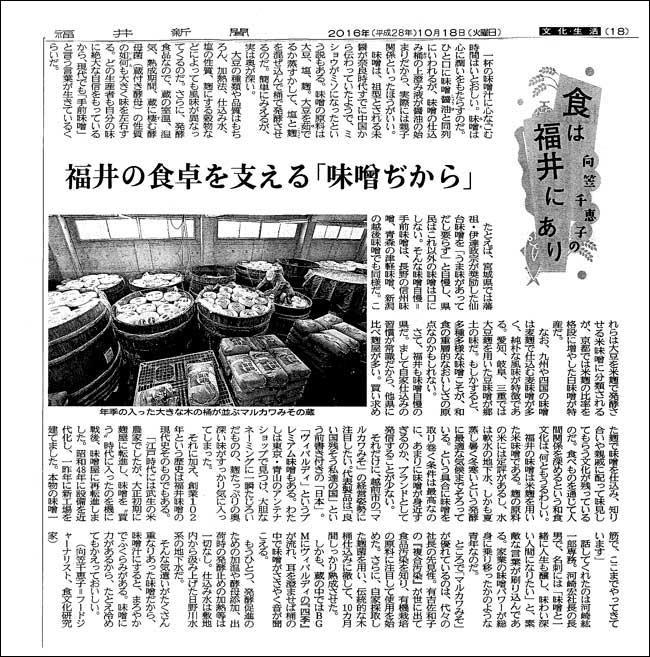
Marukawa Miso’s brewery has been making miso for nearly 100 years, resulting in a high concentration of Koji mold in the fermentation area.
As a result, when grains like soybeans are stored in the brewery, Koji mold naturally adheres to them.
This mold is used to produce miso and other fermented foods. It is pure, non-cultured, and free from chemical treatments.
**About underground water:**
It is naturally filtered groundwater.
In Fukui Prefecture in the Hokuriku region, snow accumulates in winter, and the meltwater becomes underground water that is naturally filtered before reaching the brewery, making it of the highest quality for brewing.
Many breweries seek high-quality water from remote mountain areas or pristine locations, as water significantly influences the flavor of fermented foods.
Since most sake is primarily water, and about 5 kg of water is needed to produce 1 kg of miso, the quality of water is crucial.
The moisture content of miso is approximately 50%.
Therefore, high-quality brewing water is fundamental to Marukawa Miso’s philosophy.
The water is free from chlorine smell and chlorination, and we conduct annual water quality tests.
Every year, as winter arrives and snow melts into pure water, we are grateful and dedicated to making miso with this water.
| Product # | 10000696 |
|---|
You don't need to be in Japan to shop here. Sign up for a free account on ZenPlus now and enjoy buying and shipping to over a hundred countries, directly from Japanese online stores. You can ship your items internationally through JP Post (EMS, Airmail), UPS, DHL, FedEx, and other services. Get all the hottest items from Japan such as anime figures, Nendoroids, Nintendo and other video games, Hello Kitty and other kawaii plushies, fishing tackle, Japanese street fashion, Seiko and other watches from Japan, ramen and other Japanese foods, idol merchandise, and much, much more!
We work directly with Japanese shops registered with ZenPlus, so all internal processes are faster and more efficient - the result is a swift and affordable service, ready for you when you need it most. You have instant access to over 1,000 stores in Japan with just one click! Shop just as if you were in Japan, without spending a fortune. We'll get you the best deal possible from a vast collection of items from Japan. Join the ranks of people who prefer ZenPlus as their Japanese online marketplace.
We protect you, the buyer. Communication can be one of the biggest barriers when buying from Japan online, but it doesn't have to be that way. With ZenPlus, you are protected from many of the risks of international e-commerce: We'll take care of any questions, claims, and requests for the seller that you might have. We can provide a full refund if an item is not genuine, and a partial refund if it's not as promised. Feel free to ask us for more info about any of the items or shops on ZenPlus!