


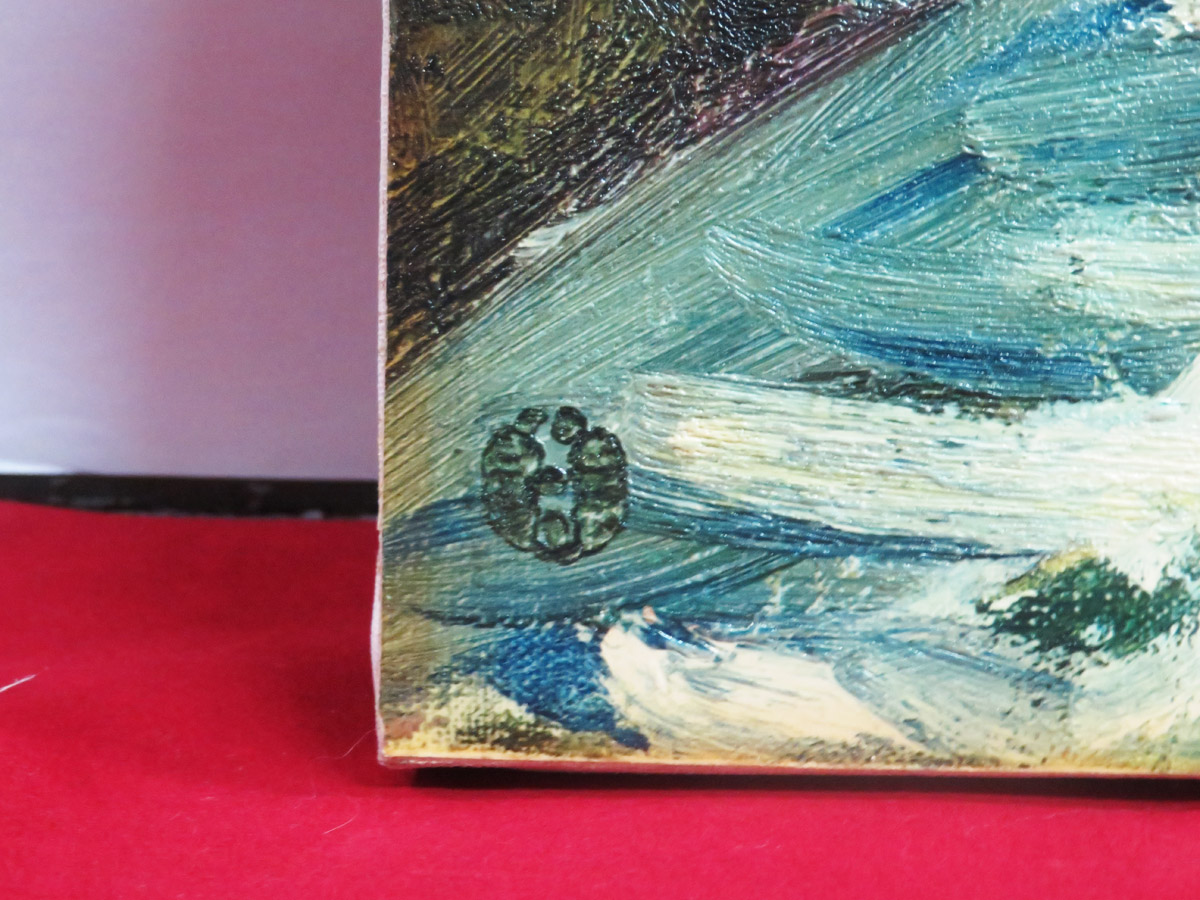

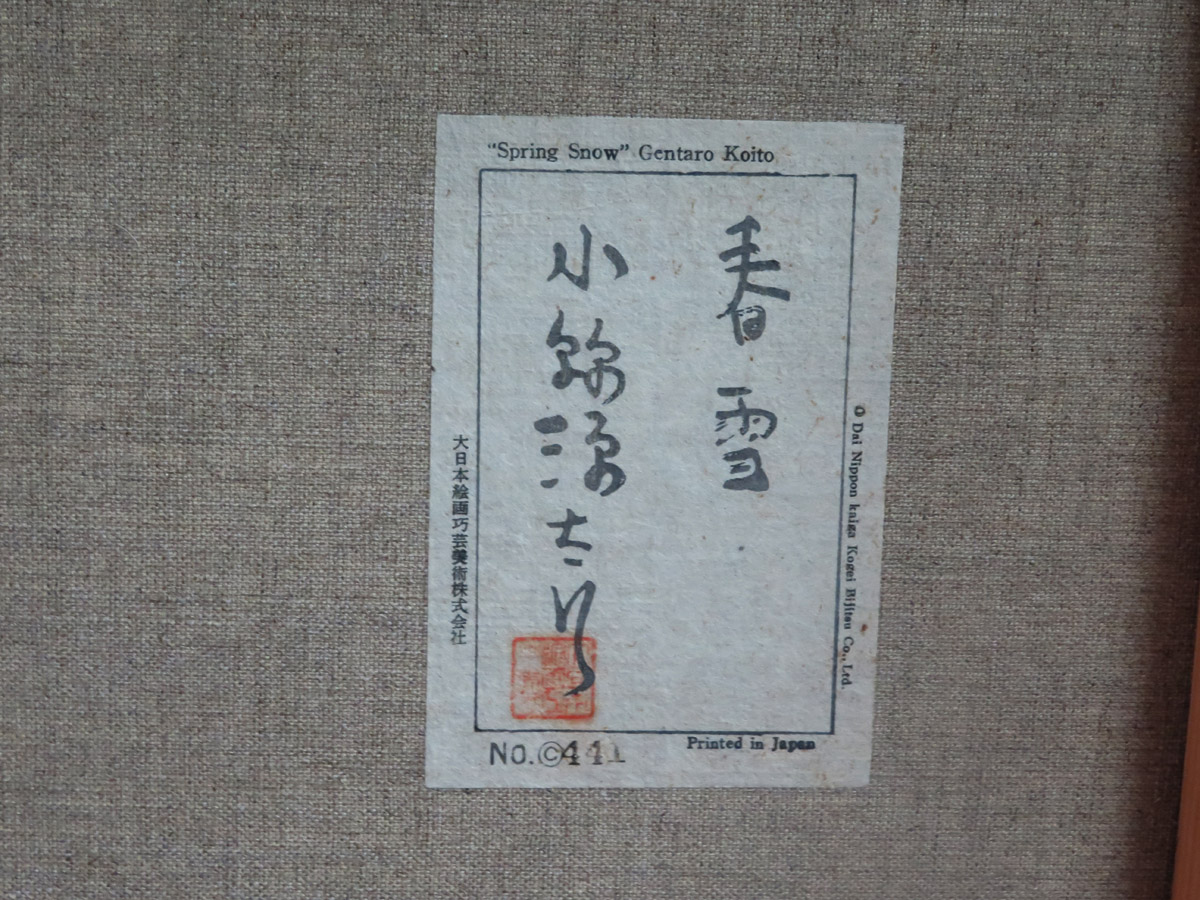
Signed by the artist, with a seal.
Developed a unique artistic style characterized by powerful brushwork, strong color contrasts, and concise forms.
Recognized by the Japan Art Academy, recipient of the Order of Cultural Merit, advisor to the Nitten exhibition.
Artwork dimensions: 45.5 x 38 cm
Framing not included.
Gentarō Koito was a painter born on July 13, 1887, in Shitaya-ku, Tokyo Prefecture (present-day Taito-ku, Tokyo), as the eldest son of a family that had run a restaurant since the Edo period.
Aspiring to be a Western-style painter, he entered the Komaba Institute of the Hakuba-kai after graduating from middle school, where he studied drawing under Takeji Fujishima. Concurrently, he received instruction in sculpture from Bisei Unno.
In 1906, he aimed to enroll in the Western Painting Department of the Tokyo School of Fine Arts but was admitted to the Metalworking Department.
In 1910, while still a student at the Tokyo School of Fine Arts, he had his work "Uogashi" (Fish Market) accepted into the 4th Bunten exhibition, marking his first successful submission.
He was recognized by Seiki Kuroda, who recommended he transfer to the Western Painting Department.
However, after graduating from the Metalworking Department in 1911, he re-enrolled in the Western Painting Department. He then took a leave of absence due to illness and ultimately withdrew from the program.
He continued his artistic activities, and his participation in the Bunten exhibitions was active.
On the first day of the 12th Bunten exhibition in 1918, Gentaro caused an incident where he destroyed his own artwork and refrained from exhibiting until 1925.
In 1922, for treatment of diabetes, he moved back to his family home in Ikebukuro from the house in Nippori, where he had lived after building a new studio following his marriage.
In September of the same year, the Nihon Bijutsuin published "Gentarō Koito Gashū Meiji 43 - Taishō 11" (Gentarō Koito Art Collection 1910-1922).
While Gentaro's early works, such as "Yane no Miyako" (City of Roofs), exhibited a style influenced by Impressionism and Post-Impressionism, he temporarily ceased exhibiting in the latter half of the Taisho period.
He returned to exhibiting at the end of the Taisho period, presenting works like "Dassai-zu" (Picture of Otter Festival) and "Sekishunpu" (Ode to Spring's End).
In the early Showa period, Koito Gentaro's works after his return to the official exhibitions primarily consisted of still lifes with meticulous detail, influenced by the Chinese academic painting style (realistic and precise).
After the war, he continued to exhibit in the Nitten, Kofu-kai, International Art Exhibition of Japan, and Contemporary Art Exhibition of Japan, developing his unique style with works such as "Sa-u Sa-sei" (Rain and Shine), "Yamashōfu" (Autumn Mountains), and "Danchi Ryōya" (Pleasant Night in the Housing Complex).
In 1954, he received the Japan Art Academy Prize for his work "Shunsetsu" (Spring Snow), which was exhibited at the 2nd International Art Exhibition of Japan the previous year, and for other landscape paintings. In 1959, he became a member of the Japan Art Academy.
"Shunsetsu" is Gentaro's representative work, depicting the tree-lined street in front of Tamadadacho Station. It conveys the atmosphere of a snowy, cloudy day rendered in a clear and strong style.
In 1960, he was appointed Director of the Nitten Foundation, and the following year, he became Managing Director of the Nitten.
In 1965, he was awarded the Order of Cultural Merit. In the same year, he became an advisor upon the establishment of the reorganized Nitten. He also enjoyed writing essays, publishing works such as "Fuyu no Niji" (Winter Rainbow) and "Fujin Raijin" (Wind God and Thunder God).
| Product # | YA-127 |
|---|
You don't need to be in Japan to shop like the Japanese. Sign up for a free account on ZenPlus now and enjoy buying and shipping to over a hundred countries, directly from Japanese online stores. You can ship your items internationally through JP Post (EMS, Airmail), UPS, DHL, FedEx, and other services. Get all the hottest items from Japan such as anime figures, Nendoroids, Nintendo and other video games, Hello Kitty and other kawaii plushies, fishing tackle, Japanese street fashion, Seiko and other watches from Japan, ramen and other Japanese foods, idol merchandise, and much, much more!
We work directly with Japanese shops registered with ZenPlus, so all internal processes are faster and more efficient - the result is a swift and affordable service, ready for you when you need it most. You have instant access to over 1,000 stores in Japan with just one click! Shop just as if you were in Japan, without spending a fortune. We'll get you the best deal possible from a vast collection of items from Japan. Join the ranks of people who prefer ZenPlus as their Japanese online marketplace.
We protect you, the buyer. Communication can be one of the biggest barriers when buying from Japan online, but it doesn't have to be that way. With ZenPlus, you are protected from many of the risks of international e-commerce: We'll take care of any questions, claims, and requests for the seller that you might have. We can provide a full refund if an item is not genuine, and a partial refund if it's not as promised. Feel free to ask us for more info about any of the items or shops on ZenPlus!